All the Ways Anxiety Could Have Shown Up This Morning
This morning I got on a plane from Canberra to Melbourne for my PhD. Early alarm, packed bag, airport, security, gate, boarding, landing. A completely ordinary trip that thousands of people make every week.
And somewhere between the front door and the arrivals hall, I started thinking about how many different ways anxiety could have hijacked it. Not just "I felt nervous", but the specific voice each type of anxiety uses, and the specific thing it would have tried to stop me doing.
So here's a tour of my morning, narrated by every anxiety that could have shown up. Then I'll tell you what actually made it hard for me as an autistic person, and why that's a different thing altogether.
The anxiety line-up
Agoraphobia: "You can't leave the house"
Agoraphobia isn't simply a fear of open spaces. It's fear of being somewhere that would be hard to escape, or where help might not be available, if panic or something embarrassing happened. Public transport, enclosed spaces, crowds and queues are the classic triggers.
An airport ticks nearly every box. A plane is the ultimate one: once the doors close, you can't get off. Agoraphobia would have said don't go, you'll be trapped, and the safest-feeling option would have been to stay home. For some people it wouldn't have got me past the front door.
Panic disorder: "What if it happens again, here?"
Panic disorder is recurrent, unexpected panic attacks plus ongoing dread of the next one. A panic attack surges fast, usually peaking within minutes: pounding heart, breathlessness, dizziness, tingling, a sense of doom or unreality.
Panic would have been scanning my body the whole morning. Is my heart racing? Is it hot in here? Every sensation becomes evidence that an attack is coming, at the worst possible moment, at 30,000 feet.
Social anxiety: "Everyone is watching you"
Social anxiety is an intense fear of being scrutinised and judged negatively. I did my makeup in the airport bathroom this morning. Social anxiety would have made that impossible: everyone can see you, they think you're vain, you're taking too long, you're in the way.
It also shows up in the smaller moments. Choosing a seat at the gate. Eating in public. Asking the flight attendant for water. Walking down the aisle past a row of faces.
Separation anxiety: "Don't leave them"
Separation anxiety disorder isn't just for kids; it can be diagnosed in adults too. It's excessive fear about being apart from someone you're attached to, often with worry that something terrible will happen to them, or to you, while you're apart.
It would have made saying goodbye to my partner this morning agonising, and filled the trip with urges to check in, check again, and imagine worst-case scenarios.
Generalised anxiety: "But what if...?"
Generalised anxiety disorder (GAD) is persistent, hard-to-control worry across many areas of life. GAD would have flooded me with what-ifs. What if the plane crashes? What if I miss the flight? What if my bag doesn't arrive? What if the meeting goes badly? What if something happens at home while I'm gone?
The worry doesn't stay on one topic. It hops from one to the next, and resolving one just makes room for another.
Specific phobias: flying, heights, enclosed spaces, vomiting
A specific phobia is an intense, out-of-proportion fear of one particular thing. Fear of flying is one of the most common. But a single flight can hit several others: claustrophobia in the cabin, acrophobia looking out the window, emetophobia (fear of vomiting) at the sight of that little paper bag in the seat pocket.
For someone with a flying phobia, turbulence isn't bumpy air. It's proof the plane is about to fall out of the sky.
Health anxiety: "That's not normal"
Health anxiety is preoccupation with having or developing a serious illness. On a plane it has plenty to work with: recycled air, coughing passengers, ear pressure, a slightly odd feeling in your leg that must surely be a blood clot.
OCD: "Check it one more time"
Obsessive-compulsive disorder has its own diagnostic category now, but anxiety drives it. Intrusive thoughts create distress, and compulsions temporarily relieve it. This morning that could have looked like checking the stove, the door, the ID and the boarding pass over and over, or needing things to feel "just right" before being able to walk out the door.
What actually made it hard for me
None of those anxieties ran my morning. What made it hard was being autistic in a space that isn't built for autistic people.
Being perceived
Airports are designed for being watched. Cameras, staff, strangers in every direction, all day. For me, the hardest part wasn't a fear of being judged so much as the sheer exhausting load of being perceived: monitoring my face, my body, my pace, whether I look "normal", for hours on end.
That's masking, and it costs real energy. By the time I reached the gate, I'd already spent a chunk of the day's capacity just existing in public.
Reading the security line
Security is one long unwritten social script. Where to stand. When to step forward. Which tray, which order, laptop out or in, shoes or no shoes. When the officer says "step through", do they mean now? Am I making too much eye contact, or not enough? Does my flat expression or my fidgeting look suspicious?
My fear wasn't irrational. It was a very reasonable worry about misreading cues in an environment where getting it wrong can mean being pulled aside, questioned, or treated as a problem. Autistic people's communication differences are genuinely misread by people in authority, and many of us have lived experience of that.
The sensory onslaught
Then there's the sensory side. Crowds pressing in. Announcements over the top of rolling suitcases, beeping scanners and a hundred conversations. Harsh fluorescent lights. Smells from the food court and the duty-free perfume counter. The roar of the engines and the cabin pressure change.
None of that is in my head. It's real input, arriving at a volume my nervous system processes differently, and it adds up across the whole journey.
Why the difference matters
Anxiety is a fear response that overestimates danger, so it's usually best managed by gently challenging it. Autistic sensory and social needs aren't a distortion, so they need to be accommodated, not challenged.
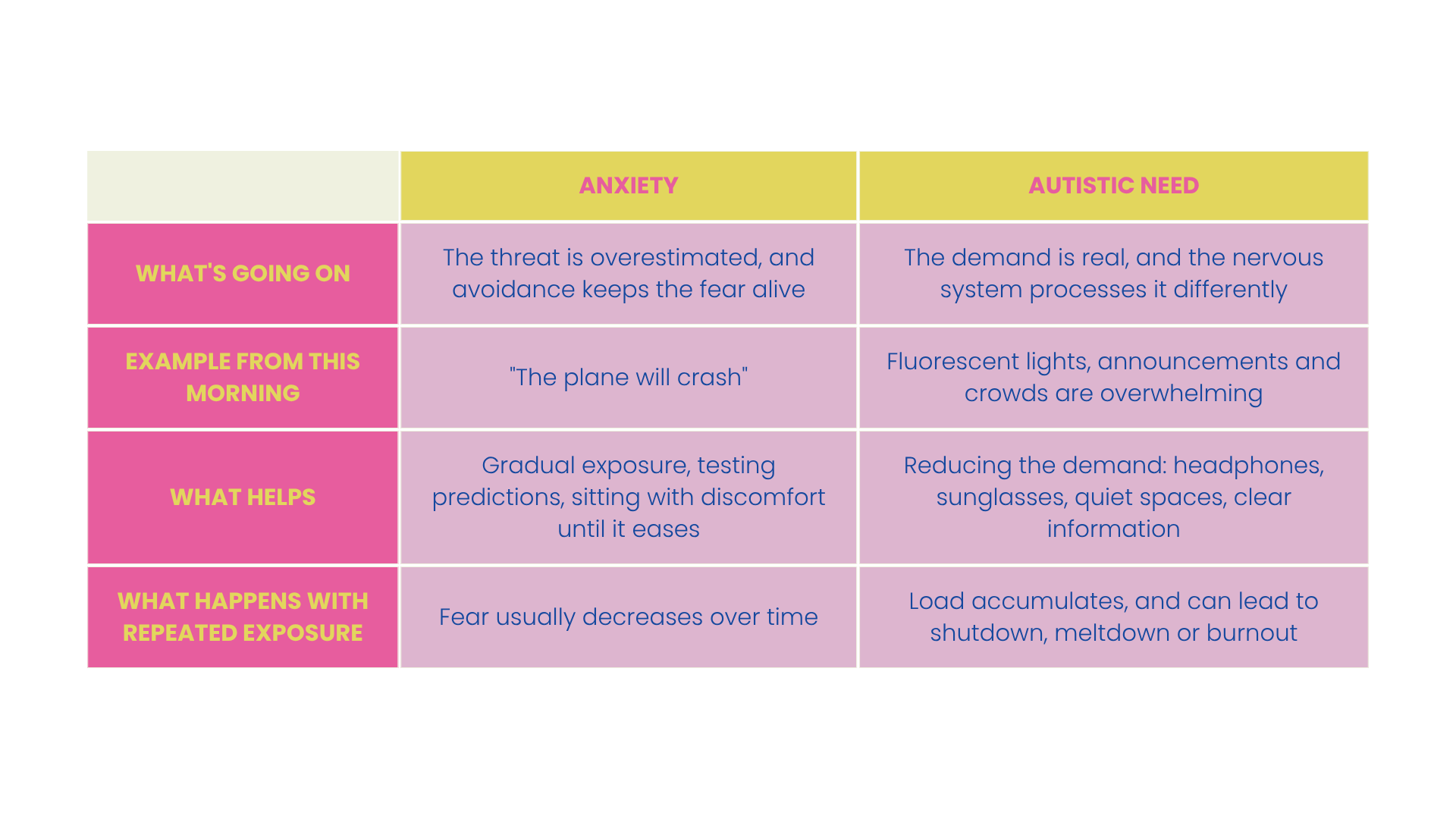
This is why "just push through it" can be good advice for a flying phobia and harmful advice for sensory overload. With anxiety, avoidance teaches your brain the danger was real. With sensory overwhelm, forcing exposure doesn't build tolerance. It drains a battery that was already running low.
It isn't always a clean split. Anxiety is very common in autistic people, and the two feed each other: unmet sensory and social needs make anxiety more likely, and anxiety turns the volume up on everything else. Part of good support, and good neuroaffirming assessment, is teasing apart which part is fear and which part is need, so each gets the right response.
What this looks like in practice
If you're autistic and travelling, you're allowed to make the journey easier on your nervous system. Some things that can help:
Noise-cancelling headphones or earplugs, and sunglasses or a cap for the lights
Travelling at quieter times, and arriving early so nothing is rushed
Looking up the security process and airport map beforehand, so the script isn't a surprise
The Hidden Disabilities Sunflower lanyard, which many airports recognise as a quiet signal that you may need extra time or support. I wore mine this morning, and several staff checked in to ask if I needed help, without me having to explain anything
Telling staff you're autistic, if and when that feels safe
Planning recovery time on the other side, not just the trip itself
And if anxiety is part of the picture too, that's worth working on, with the same compassion. The goal isn't to fear less of the world by shrinking it. It's to meet your real needs so there's enough capacity left to face the fears that are lying to you.
This morning I made it to Melbourne. Not because I pushed through everything, but because I knew which things needed pushing and which things needed protecting.