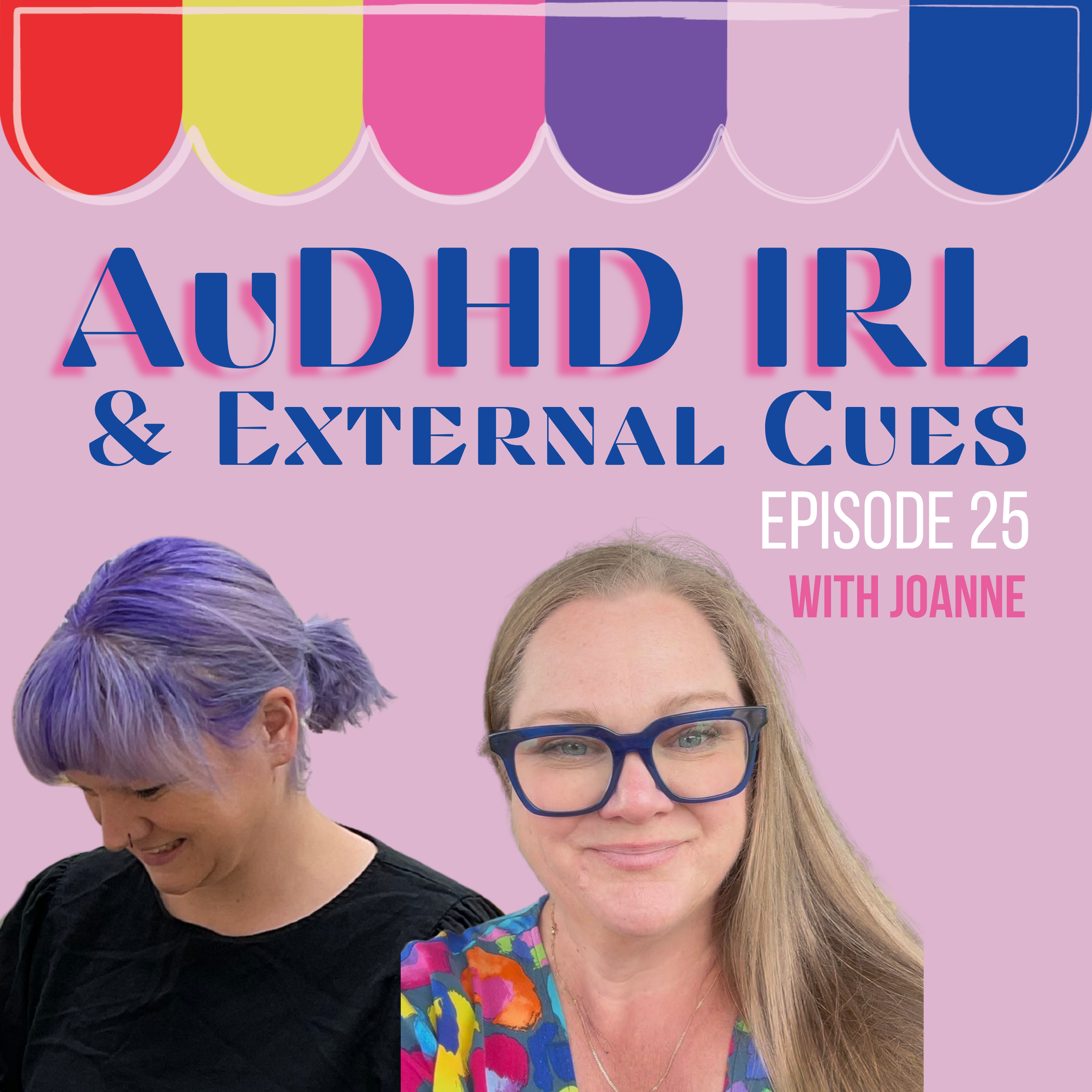
Ep.25/ AuDHD & External Cues That It’s Regulation Time with Joanne
Bri and Joanne chat through a whole bunch of external cues (the birds) that you, and AuDHDer, might be struggling or dysregulated (the fish - it’ll make sense when you listen).
Listen HERE
Content warning:
If you don't like swearing, scroll on by
Summary:
This week I'm joined by Joanne Hatchard: award-winning neurodivergent therapist, social worker, parent and founder of Better Being Me (and host of the wonderful Talking Twaddle). I'll be honest, when Joanne first pitched this topic I said "heck yes" and then immediately thought "wait, I have no idea what that means." So this episode is me asking a lot of genuine questions while Joanne generously info-dumps a framework that turns out to be one of the most useful reframes I've come across in ages.
Here's the big idea. When you go fishing you can't see the fish, because they're underwater. But you can see the birds circling overhead, and the birds tell you where the fish are. Our internal cues (the "fish") are notoriously unreliable when we're AuDHD, especially when we're stressed, and our interoception has quietly left the building. But the external cues (the "birds") are right there for us, and for the people around us, to spot.
We get into the seven areas Joanne watches: decision-making and the dreaded dithering, outsourcing your choices to other people's opinions, executive functioning weaknesses like a working memory that ghosts you mid-sentence, stress behaviours mapped through the OCEAN traits, attachment that shifts depending on whether it's your mum or your mates at the door, masking as a safety tool rather than a knee-jerk, and connection through the lens of polyvagal safety. There's also a penguin that made Joanne cry, which turns out to be a perfectly valid bird.
The thread tying it together is language. This stuff doesn't work alone in your own head. It works when you and a trusted person build a shared vocabulary for what your stress looks like from the outside, so someone can gently flag it before the meltdown that supposedly "came out of nowhere."
Takeaways
Your internal radar is the least reliable thing to lean on when you're stressed, because stress is exactly when it stops working. The external cues are easier to catch, and other people often see them first.
A "bird" is anything observable that flags your capacity is dropping: dithering over a simple decision, losing your words, crying at a penguin, suddenly hearing the electrical hum, chewing your cheek, looping on the same sentence. Once you can name them, you can act on them.
Naming the birds out loud changes everything. It moves you from "life is happening to me" to "I'm stressed and I can do something about that," and it gives the people who love you a kind way to flag it instead of slowly drifting away confused.
You don't have one attachment style, you have a different one for nearly every relationship. Mum at the door versus friends at the door can produce two completely different versions of you.
Masking isn't the enemy. Used intentionally, when you've got the reserves for it, it's a powerful tool. The problem is when it's a default instead of a choice, and you've got nothing left by the time you get home.
The trusted person matters more than the perfect system. It can be a friend, a partner, or a professional you pay to be honest with you. What you need is someone willing to tell you the truth.
And the gentlest one to finish on: it doesn't need to be fucking hard. The supports that actually stick are usually the simplest ones, and you're allowed to cherry-pick the bits that work for you and leave the rest.
You can find Joanne on Instagram at @betterbeingme_bbme.